Myanmar’s Military Offensive Deepens Regional and Diplomatic Strains
Airstrikes and a ground offensive around the proposed Dawei port show Myanmar’s military pressing harder to reclaim territory, with mounting civilian casualties, displacement and uncertainty over strategic projects. Regional diplomacy is moving in competing directions: Russia is deepening ties with Min Aung Hlaing, Bangladesh is pressing Myanmar and the Arakan Army over Rohingya returns, and China is rejecting a US detention designation—while disputes over facts, identity and accountability remain unresolved.
Monday, Aug 24, 2026
Tracking: NUG · Rohingya · Myanmar
Geography: Myanmar, Rakhine State, Bangladesh, Cox's Bazar
1. Airstrike Kills 14 at Buddhist Monastery in Myanmar’s Sagaing Region

On Friday, a Myanmar military airstrike hit a Buddhist monastery in Swel Le Oh village, Myaung township, in Sagaing Region.
The CDSOM said 14 people, including three women, were killed and 20 wounded; a local resident separately confirmed the death toll and said two bombs fell 15 minutes apart. More than 100 people were attending a weeklong meditation retreat for Buddhist Lent.
Myaung lies in Sagaing, a stronghold of armed resistance, where the military has increasingly used airstrikes.
The military did not immediately comment, while its foreign ministry rejected a UN investigative mechanism’s finding of intensified aerial attacks, saying operations target armed groups and avoid civilian harm; the IIMM says strikes increased before elections held in December and January and continued afterward.
Key facts:
Friday’s strike hit Swel Le Oh village in Myaung township, about 75 kilometers west of Mandalay.
CDSOM reported 14 deaths, including three women, and 20 injuries.
A resident said two bombs fell 15 minutes apart during a Buddhist Lent retreat.
More than 100 people attended a weeklong meditation retreat.
IIMM reported intensified aerial attacks before December-January elections and continuing afterward.
Why it matters: Because the monastery served as a retreat site, the reported attack underscores how fighting in Sagaing reaches civilian and religious spaces, not only battle positions.
The military’s airpower gives it an advantage the resistance lacks, while the competing accounts—an intentional attack according to rebel witnesses versus legitimate-target operations according to the military—will shape accountability debates.
Residents reportedly fled to a nearby community after cremating victims. If the IIMM’s assessment of continued air attacks is substantiated, civilian protection will remain a central test of the military’s post-election rule.
2. Myanmar Offensive Targets Area Around Russia-Backed Dawei Port

Since July, about 700 Myanmar military troops have moved into villages around the proposed Dawei Special Economic Zone in Tanintharyi Region, Reuters reported through The Defense Post.
Local sources said the offensive included air and naval strikes, village raids, home burnings, civilian killings and displacement; three humanitarian workers were reportedly detained and killed.
The operation is intended to secure territory for a long-delayed deep-sea port, power plant, industrial facilities and transport links to Thailand, though it remains unclear whether construction has resumed.
President Min Aung Hlaing discussed the project with Vladimir Putin, while Russian Prime Minister Mikhail Mishustin said Russian companies planned to participate.
The offensive is part of a wider campaign to retake border areas, trade routes and economically important territory from opposition forces, amid a new UN report documenting intensified attacks on civilians.
Key facts:
About 700 troops reportedly entered villages around Dawei’s proposed economic zone since July.
Air and naval strikes reportedly accompanied raids, killings, displacement and home burnings.
Three humanitarian workers were reportedly detained and killed.
Dawei plans include a deep-sea port, power plant, industry and links to Thailand.
Russia says its companies plan to participate in reviving the project.
Why it matters: The Dawei offensive links the military’s effort to reclaim territory with plans to revive strategic infrastructure.
If control expands, the project could create a trade corridor bypassing the Strait of Malacca, shorten cargo journeys by four to six days and give Russia a commercial foothold in the Indian Ocean region.
For local communities, the reported killings and displacement make any project revival inseparable from civilian-protection and accountability concerns.
The next indicators are whether military control expands, construction resumes and Russian participation moves from announced plans to activity.
3. Bangladesh Presses Myanmar and Arakan Army on Rohingya Repatriation
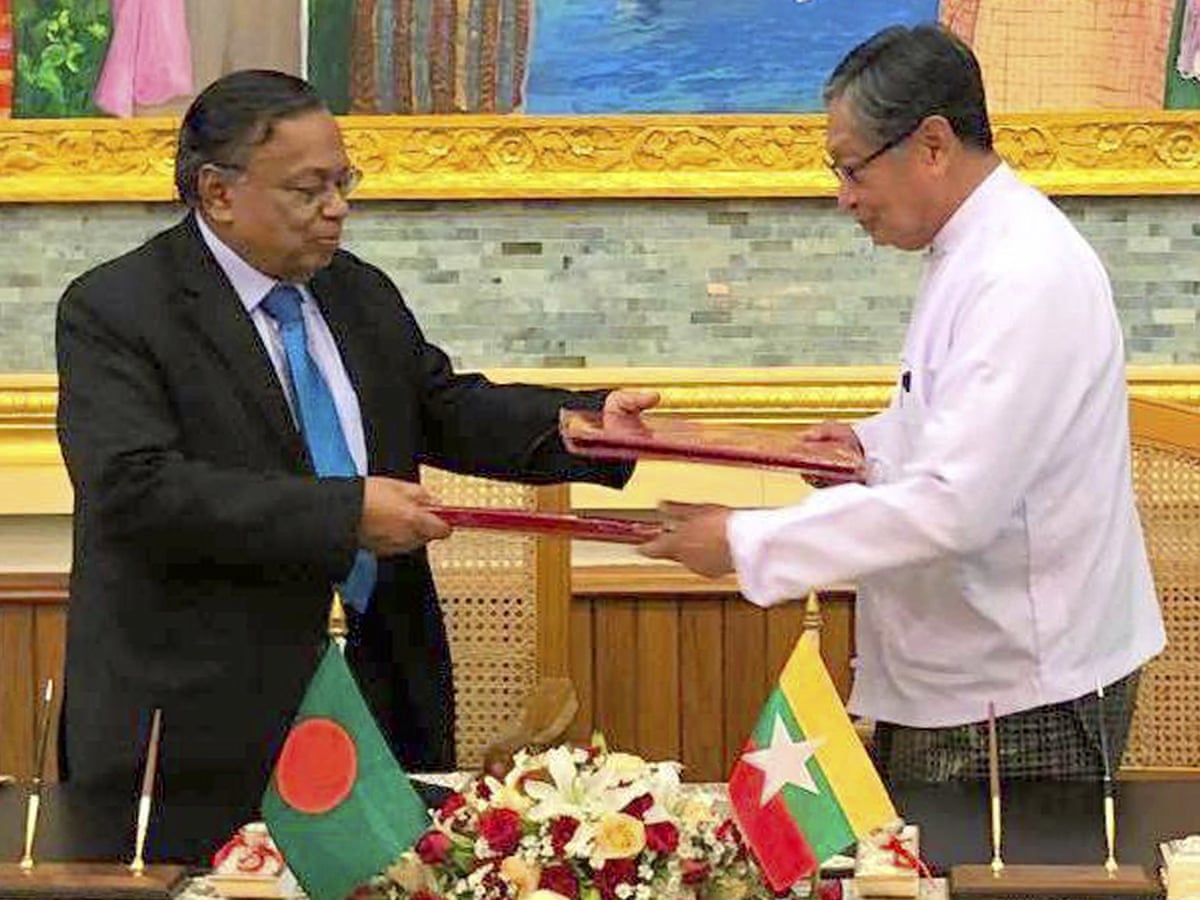
Bangladesh is pressing Myanmar and the Arakan Army to enable Rohingya repatriation, while rejecting Naypyidaw’s description of Rohingyas as “Bengalis.
” On 18 August, Foreign Affairs State Minister Shama Obaed said Bangladesh recognizes Rohingyas as having their own identity and expects any return to be under that identity.
Dhaka also challenged Myanmar’s 15 August figures on forcibly displaced Rohingyas, saying UN-registered figures are accurate.
It says 828,824 people are in the existing caseload, while additional arrivals—including children born in Bangladesh’s camps and people who fled Rakhine State after 2017—are being registered.
A separate 20 August report said Bangladesh brought home Rohingya and fishermen detained by the Arakan Army, underscoring that repatriation diplomacy is unfolding alongside direct security incidents.
Key facts:
18 August: Shama Obaed rejected Myanmar’s “Bengali” label for Rohingyas.
Bangladesh lists 828,824 Rohingyas in its existing UN-linked caseload.
Dhaka is registering additional arrivals, including children born in Bangladesh’s camps.
Bangladesh says repatriation pressure must target both Myanmar and the Arakan Army.
A 20 August report said Bangladesh brought home Rohingya and fishermen detained by the Arakan Army.
Why it matters: Dhaka is trying to keep bilateral verification alive without accepting Myanmar’s terminology or figures.
That balancing act preserves a diplomatic route toward repatriation, but Bangladesh’s insistence on Rohingya identity and inclusion of newer arrivals creates additional issues for the verification process.
The Arakan Army’s involvement makes the crisis broader than a Myanmar-Bangladesh administrative negotiation.
Bangladesh says international pressure must reach both Myanmar and the Arakan Army; the next tests are whether Myanmar incorporates the additional registration data, whether verification accelerates, and whether outside pressure produces further returns or releases.
4. Putin Hosts Min Aung Hlaing as Myanmar Seeks Deeper Russian Ties

On August 18, Russian President Vladimir Putin hosted Myanmar President Min Aung Hlaing in Moscow for talks intended to deepen economic and security cooperation.
Putin said the countries had worked together on foreign-policy and security issues; they have also held joint military drills and planned major projects, including a nuclear power plant, seaport and oil refineries.
The visit is Min Aung Hlaing’s latest effort to rebuild diplomatic standing after the military’s 2021 seizure of power, which left Myanmar largely isolated internationally.
The South China Morning Post said he was seeking an economic reboot for a war-ravaged country, alongside supplies of fertiliser, oil and weapons, while also noting his role as army chief during the ethnic cleansing of the Rohingya and his subsequent appointment as president after a military-backed election.
Key facts:
Putin hosted Min Aung Hlaing in Moscow on August 18, 2026.
Russia and Myanmar have held joint military drills.
Planned projects include a nuclear power plant, seaport and oil refineries.
Min Aung Hlaing recently visited China, India, Laos and Thailand.
Myanmar is seeking fertiliser, oil and weapons, according to the South China Morning Post.
Why it matters: The meeting gives Myanmar’s military-backed government a high-profile partner while it remains largely isolated internationally.
Russia benefits by expanding security and economic links with a government seeking arms, fuel and industrial investment; the stated project pipeline could give Moscow a longer-term presence in Myanmar, though the reports describe plans rather than completed deals.
For Min Aung Hlaing, the diplomatic sequence—from neighboring Asian capitals to Moscow—helps present foreign engagement as continuing despite the 2021 coup and the military’s role in the persecution of the Rohingya.
It does not by itself show broader international acceptance or any improvement in Myanmar’s conflict. The next concrete indicator is whether talks produce agreements or deliveries involving weapons, oil, fertiliser or proposed infrastructure projects.
5. Bangladesh Rejects Myanmar’s Rohingya Figures, Urges Faster Verification

Bangladesh has rejected figures and descriptions in Myanmar’s 15 August statement on Rohingya displacement, calling the statistics erroneous and objecting to labeling Rohingyas “Bengalis.
” On Tuesday, Director-General Md Toufiq-ur-Rahman raised the objections with Myanmar’s ambassador, U Kyaw Soe Moe, in Dhaka.
Bangladesh urged Myanmar to speed identity verification under bilateral arrangements, including children born in camps and arrivals since the 2017 exodus.
Myanmar’s ambassador promised to convey the concerns to Naypyidaw and said Myanmar remained committed to speeding verification so repatriation of verified Rohingyas could begin.
But more than one million Rohingyas remain in Bangladesh, and State Minister Shama Obaid said Rakhine State’s changing power balance and the Arakan Army mean Dhaka must deal with multiple stakeholders.
Bangladesh plans to seek greater international pressure through September’s UN General Assembly discussions and the International Court of Justice’s proceedings.
Key facts:
Myanmar issued its latest Rohingya statement on 15 August, prompting Bangladesh’s diplomatic objections.
Bangladesh says UN-registered figures better reflect Rohingyas in its shelters.
The original bilateral caseload was 828,824 people.
More than one million Rohingyas remain in Bangladesh after the 2017 mass displacement.
Bangladesh says Arakan Army involvement complicates a process once handled through Myanmar’s government.
Why it matters: The dispute is not only about statistics. Bangladesh’s insistence on Rohingya identity and on including camp-born children and later arrivals could affect who is counted, verified, and ultimately considered for return.
Myanmar’s promise to accelerate the process offers diplomatic movement, but no return timetable; Dhaka still says repatriation must be safe, dignified, voluntary, and secure. The political setting in Rakhine State makes the bilateral mechanism harder to use.
Bangladesh is signaling that Myanmar’s authorities alone may not control the conditions for return, while seeking leverage through the United Nations, the International Court of Justice, and regional powers including China.
The immediate next test is whether verification expands beyond the original caseload and produces an actual pathway to return.
6. China Rejects US Wrongful-Detention Designation for Myanmar Analyst Min Zin
China has rejected Washington’s designation of US citizen and Myanmar analyst Min Zin as “wrongfully detained,” saying he is suspected of activities endangering China’s national security.
Min Zin was detained in Yunnan on June 3 after travelling to an academic conference at the Chinese government’s invitation.
The US State Department says the designation makes securing his release a priority and is also seeking the release of another American, Youlin Chen.
China’s position directly conflicts with Washington’s and adds a human-rights dispute to already tense US-China relations, weeks before President Xi Jinping’s planned September 24 White House visit.
Min Zin co-founded the Institute for Strategy and Policy-Myanmar, a Thailand-based think tank examining Myanmar’s political, economic and conflict dynamics, including China’s influence in border areas.
Key facts:
Min Zin was detained in Yunnan on June 3 after attending a Chinese government-invited academic conference.
Washington designated him wrongfully detained on Thursday, making his release a priority.
China says Min Zin is suspected of activities endangering national security and violating Chinese law.
Xi Jinping’s planned September 24 White House visit follows Trump’s May Beijing summit.
Min Zin co-founded the Institute for Strategy and Policy-Myanmar, which studies Myanmar’s civil war.
Why it matters: The designation turns Min Zin’s detention into a formal US diplomatic priority just weeks before Xi’s planned Washington visit.
Beijing’s insistence that he violated national-security laws gives China a direct basis to reject Washington’s demand, making the case a potential irritant in efforts to improve relations.
For Myanmar’s conflict watchers, the detention also highlights the sensitivity of research on China’s role in Myanmar’s borderlands.
Min Zin’s institute examines those political and conflict dynamics, while China is described as backing Myanmar’s military administration and facing accusations of supporting armed organisations aligned with its interests.