WHO Europe adopts healthcare AI roadmap; review identifies expanding uses and unresolved safeguards
Healthcare AI is expanding from clinical decision support and documentation to surgical robotics and other commercial tools, while governance is still developing. WHO Europe’s roadmap and the new review converge on the need for stronger data infrastructure, external validation, transparency, workforce training, and post-deployment monitoring; readers should watch how those safeguards keep pace with adoption.
Tracking: Medicine Robotics · AI Medicine · AI Healthcare
WHO Europe adopts first regional roadmap for healthcare AI

Fifty-three WHO European Region member states unanimously adopted the region’s first shared roadmap for artificial intelligence in healthcare on November 3.
Covering 2026–2033, it calls for coordinated governance, stronger data and digital infrastructure, workforce training, and safeguards covering AI development, validation, deployment, and monitoring.
The policy shift arrives as commercial deployment accelerates.
Stryker announced an estimated $400 million preferred-equity investment in CMR Surgical, including exclusive US distribution rights for its Versius surgical robot, while Deutsche Telekom invested in clinical-AI assistant Tandem Health.
A separate India–US regulatory study highlights the unresolved gap between rapid adoption and rules governing safety, transparency, patient data, consent, and access.
Key facts:
Why it matters: The WHO agreement gives governments a shared template for deciding who is responsible when clinical AI is introduced, how systems should be evaluated, and what infrastructure they require.
Its emphasis on interoperability, cybersecurity, workforce skills, and post-deployment monitoring shifts attention from promising demonstrations to routine operation in healthcare settings.
Commercial deals show that this governance challenge is arriving alongside rapid market expansion in surgical robotics and clinical software.
Countries may gain from common standards and implementation support, while developers face more scrutiny over evidence, data handling, transparency, and measurable clinical benefit.
The next test is whether the roadmap produces funded national strategies and consistent oversight rather than another high-level commitment.
New review maps healthcare AI’s expanding uses and unresolved safeguards
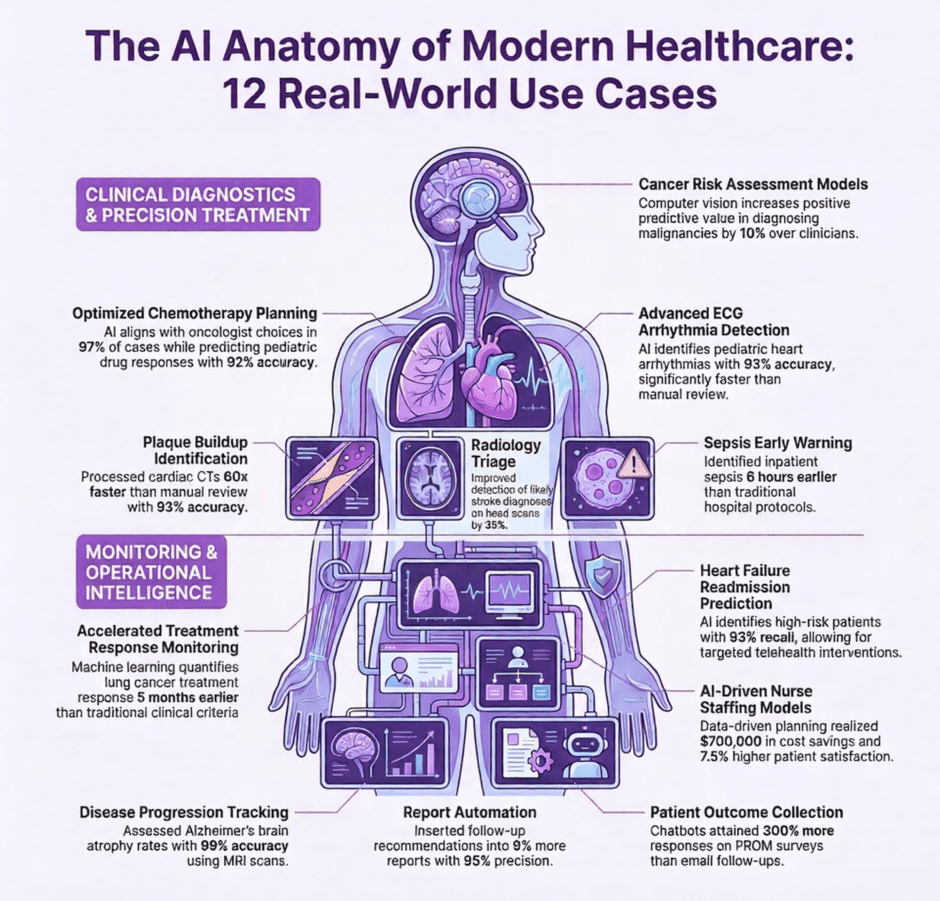
A new narrative review published by MDPI on November 1, 2026, describes how large language models and generative AI are being positioned across healthcare.
It covers clinical uses including early disease detection, medical imaging, personalized medicine, and chronic-disease monitoring, alongside administrative tools for documentation, electronic health records, patient interaction, and patient-flow management.
The review uses oncology as an illustrative setting, tracing a path from IBM Watson for Oncology to contemporary platforms such as Tempus and PathAI.
It says ambient documentation has reduced administrative burden in some studies, but stresses that evidence remains early and context-dependent.
The authors identify opacity, automation bias, unequal datasets, and weakened documentation rigor as risks, while urging external and prospective validation, reporting standards, and post-deployment monitoring.
Regulators are also developing oversight frameworks.
Key facts:
Why it matters: The review frames adoption as a workflow and governance challenge, not simply a model-performance contest.
AI could support disease detection, tailored care, chronic-illness monitoring, and documentation, but results may vary with infrastructure, clinical context, and data representation.
The next test is whether systems are evaluated prospectively outside development settings, integrated with clinician judgment, and monitored after deployment.
Without those controls, opacity, automation bias, inequitable datasets, and less rigorous automated notes remain unresolved risks for healthcare organizations, clinicians, and patients.