Surgical-robot market forecast reaches $59.55 billion; review favors assistive healthcare AI
Healthcare technology is expanding on two fronts: a new forecast projects sharp growth in surgical robotics, while a 28-publication synthesis finds the strongest evidence for assistive, context-specific AI rather than autonomous replacement. The key question is whether deployment is matched by target-setting validation, human oversight, traceability, equity and safety checks, and continuous monitoring.
Tracking: Medicine Robotics · AI Medicine · AI Healthcare
New Forecast Projects Surgical Robots Market Reaching $59.55 Billion by 2035
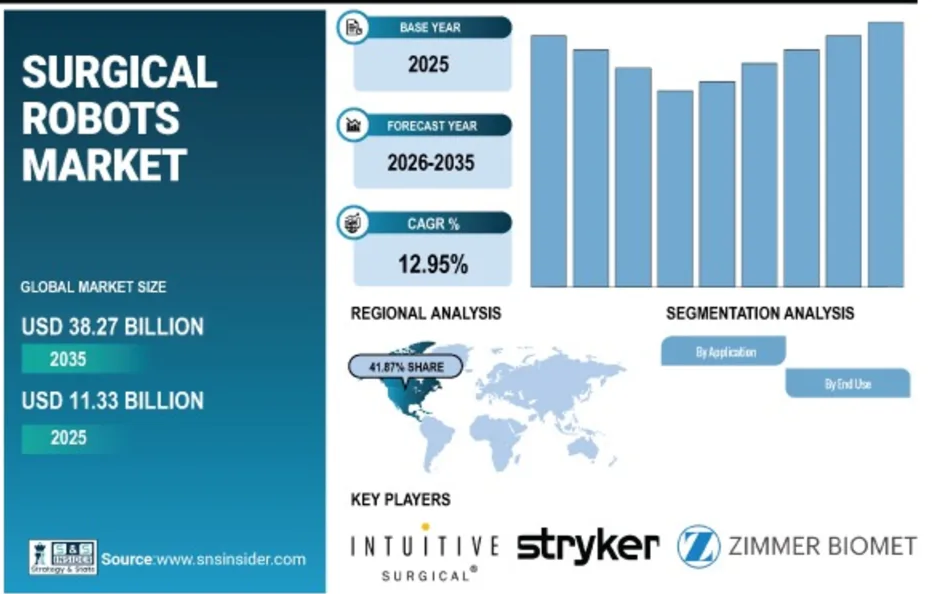
ResearchAndMarkets.com added a 2026–2035 surgical-robots market report on October 22, forecasting growth from $12.93 billion in 2025 to $59.55 billion in 2035, a 16.50% CAGR.
The report attributes the outlook to demand for minimally invasive surgery, technology innovation, healthcare-infrastructure investment, and regulatory approvals.
It says artificial intelligence, machine learning, advanced imaging, haptic feedback, precision control, single-port platforms, and wireless connectivity are expanding robotic capabilities across specialties.
Hospitals and clinics are expected to remain the main end users, while North America is projected to hold a major share.
The report also points to Johnson & Johnson MedTech’s 2024 FDA authorization for OTTAVA clinical trials and Sysmex’s first overseas hinotori prostatectomy in Singapore as milestones supporting competition and international expansion.
Key facts:
Why it matters: The forecast points to a larger commercial market for robotic surgery platforms and the software and hardware supporting them.
Hospitals are positioned as the main buyers, while manufacturers are competing on AI-enabled decision support, imaging, precision control, portability, connectivity, and broader procedural coverage.
The cited OTTAVA and hinotori milestones show how regulatory progress and clinical use outside a platform’s home market could shape competition.
The next developments to watch are additional approvals, expansion into more specialties, and whether newer systems become compact and cost-effective enough for wider hospital adoption.
New Healthcare AI Review Favors Assistive Tools Over Autonomous Replacement

A new critical narrative synthesis of 28 healthcare-AI publications finds that technical performance and workflow benefits are better documented than clinical outcomes, patient safety, economic effects, or post-deployment surveillance.
The review covers diagnosis and imaging, prediction and monitoring, documentation, conversational systems, public health, hospital operations, and specialty applications. Its evidence counts are descriptive rather than representative of the entire field.
The synthesis says the evidence more consistently supports assistive, context-specific AI than generalized autonomous replacement.
It calls for clearly defined intended uses, governed data, validation in the target setting, risk-proportionate human oversight, traceability, equity and safety assessment, continuous monitoring, and controls to restrict, suspend, or withdraw systems when conditions change.
Recurrent risks include poor generalizability, bias, miscalibration, hallucinations, opacity, privacy problems, interoperability failures, unclear accountability, and hidden costs.
Key facts:
Why it matters: The review raises the implementation bar for hospitals, developers, and clinicians: technical accuracy is only one part of proving that an AI system is useful and safe.
Deployment decisions increasingly need to account for local validation, human responsibility, equity, and whether performance changes after launch. The practical consequence is a shift from one-time approval toward life-cycle governance.
Organizations adopting these tools will need mechanisms to monitor real-world behavior and restrict or withdraw systems when data, workflows, or risks change; developers that cannot support those controls may face harder paths to sustained clinical use.