Surgical Robots Gain Infrastructure—and a Test for Safety
Surgical robotics is moving beyond standalone devices toward durable research partnerships and integrated systems, including a five-year innovation center and an MRI-linked neurosurgery platform. The proposed IDEAL framework underscores the need to evaluate these advances across their full lifecycle, while the unverified Engineer article reinforces the importance of evidence before claims about performance, oversight, or patient impact can be made.
Thursday, Aug 27, 2026
Tracking: Medicine Robotics · AI Medicine · AI Healthcare
Smith+Nephew and Imperial launch five-year surgical robotics center

Smith+Nephew and Imperial College London have launched a surgical robotics innovation center through a five-year partnership, according to Today’s Medical Developments.
The initiative brings a medical technology company and a university together in a sustained program focused on research and innovation in surgical robotics.
The announcement signals a move toward structured collaboration rather than a single product release, with the partners seeking to deliver what the publication calls “breakthrough research and innovation.
” The confirmed development is the partnership and the center itself; the report does not establish a specific device, clinical deployment, or patient outcome. Those future details will determine how the initiative affects surgeons, hospitals, and patients.
Key facts:
Smith+Nephew and Imperial College London launched the surgical robotics innovation center.
The partnership is scheduled to run for five years.
The initiative aims to deliver research and innovation in surgical robotics.
Why it matters: The center creates a formal pathway for combining Smith+Nephew’s medical-technology capabilities with Imperial College London’s research capacity.
That could help move surgical-robotics concepts toward practical development, although the announcement alone does not establish clinical use or benefit.
The main developments to watch are the projects the center selects, whether any technologies enter clinical evaluation, and how the partners demonstrate safety and effectiveness before adoption.
AiM and Siemens Link MRI Scanners to Robotic Neurosurgery Platform
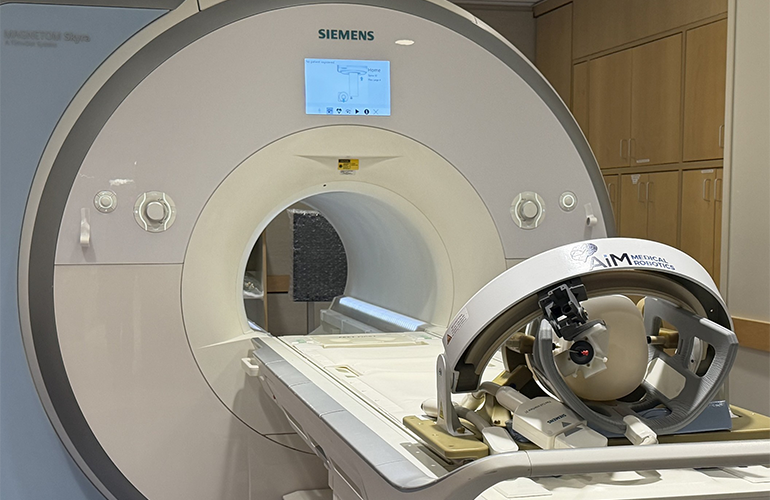
On May 26, 2026, AiM Medical Robotics announced a collaboration with Siemens Healthineers to implement an interface connecting AiM’s MRI-compatible robotic stereotactic neurosurgery system with Siemens MAGNETOM scanners.
The software is designed to exchange data and support coordinated robot–MRI operation across 1.5T, 3T, and 0.55T systems, including the MAGNETOM Free. XL.
AiM says the platform is intended for precise placement of neurostimulator leads, tumor and epilepsy ablation, biopsies, and therapeutic delivery while maintaining real-time MRI visualization.
Siemens has expressed interest in broader synchronization and compatibility work, while AiM says it plans to add artificial intelligence for workflow optimization and real-time predictive insights.
The announcement advances technical integration, but clinical deployment is described as a future step rather than a reported outcome.
Key facts:
Agreement announced May 26, 2026, enables AiM’s platform to interface with Siemens Healthineers MRI systems.
Compatibility spans Siemens 1.5T, 3T, and 0.55T MAGNETOM scanners, including MAGNETOM Free.XL.
AiM’s system targets lead placement, tumor and epilepsy ablation, biopsies, and therapeutic delivery.
Gregory Fischer said the collaboration supports AiM’s roadmap toward clinical deployment.
Siemens expressed interest in broader software synchronization through its third-party collaboration framework.
Why it matters: Interoperability is the immediate practical gain: AiM’s robot can connect with an existing Siemens MRI ecosystem rather than requiring a standalone imaging environment.
That could broaden the equipment base for MRI-guided neurosurgery and support AiM’s stated goals of faster, safer, and more accessible interventions, although those benefits remain prospective.
The next question is whether the interface develops into deeper synchronization and then clinical deployment.
AiM’s proposed artificial-intelligence layer could eventually optimize workflows and provide predictive insights, but the announcement reports no clinical outcomes or validation results for those capabilities.
Nature paper proposes lifecycle evaluation for surgical robots
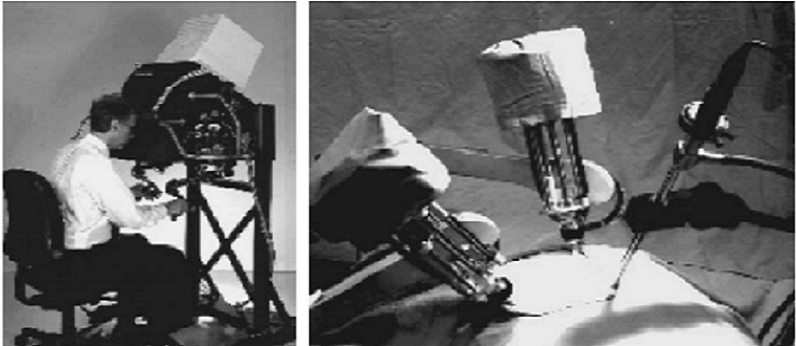
A Nature paper published on January 19, 2024, argues that surgical robotics needs a dedicated evaluation framework as control systems and artificial intelligence expand robots’ capabilities.
The field has moved from the PUMA560, used for a computed tomography-guided brain biopsy in 1985, toward systems promising greater precision, telesurgery and more complex autonomous functions.
The proposed IDEAL framework is intended to guide surgical robots from development through comparative evaluation and long-term monitoring.
The authors say the spread of platforms creates safety and ethical challenges that reach beyond the operating room, while existing research templates are too limited for the task.
The immediate development is therefore an evidence framework—not a new robot or a clinical performance result—designed to support safer translation as robotic systems become more capable and widespread.
Key facts:
PUMA560 performed a CT-guided brain biopsy in 1985.
The Nature article was published on January 19, 2024.
The proposed framework covers development, comparative evaluation and long-term monitoring.
Authors say existing evaluation templates are too limited for surgical robotics.
AI and robotic control advances may enable increasingly complex autonomous functions.
Why it matters: The paper’s main contribution is methodological: it treats surgical robots as technologies requiring evidence across their full development and clinical translation, rather than one-time testing.
That could give developers, clinicians and health systems a more consistent basis for judging new platforms as capabilities expand. The downstream question is whether the framework becomes accepted and used in practice.
Its emphasis on comparative evaluation and long-term monitoring also signals that technical novelty alone should not establish clinical value; safety, ethics and wider healthcare effects must remain part of the assessment.
The Engineer article on surgical robotics was inaccessible for verification
The supplied May 7, 2026 article from The Engineer cannot support a substantive developments report.
Its page displayed a security-service bot-verification screen rather than the article’s reporting, leaving the underlying study, authors, findings, and regulatory proposals unverified.
The search snippet indicates a discussion of AI-driven surgical robotics and updated oversight, but it is orientation material rather than article evidence.
No claims about clinical performance, regulatory decisions, patient outcomes, or named actors can therefore be responsibly presented from this source.
Key facts:
The supplied article is dated May 7, 2026.
The page displayed a bot-verification screen instead of readable article content.
The article text provides no study findings or regulatory proposals.
The source is titled “AI in surgical robotics raises regulatory questions.”
Why it matters: Without readable primary reporting, readers cannot assess whether the item describes a new study, a policy proposal, or commentary. Publishing the snippet’s claims as established facts would risk overstating developments in a safety-critical field.
The next useful step is to verify the underlying study or regulatory document through an accessible source. Until then, no concrete change in surgical-robotics oversight or clinical practice is established here.