Senate blocks fast-track ratepayer bill; Pennsylvania warns of shortfalls; Los Angeles temporarily bans large AI data centers
Data-center expansion is meeting resistance over who pays for new power infrastructure and whether regional grids can keep up. Congress is divided over a ratepayer framework, while Los Angeles County has imposed a temporary ban and cities including Cleveland, Philadelphia and San Jose are considering tighter local controls.
Friday, Sep 18, 2026
Tracking: Data Center · Data Centre
Senate Blocks Fast-Track Data Center Ratepayer Bill
Congressional efforts to make large data centers bear more of their grid costs hit a setback on September 17, when the Senate blocked expedited consideration of the Ratepayer Protection Act.
The move followed the House’s overwhelming passage the previous day; reports differ on the tally, citing 417-3 and 413-3.
The bill would direct state regulators to consider standards requiring large loads to cover the full incremental costs of generation, transmission, substations and distribution upgrades.
It would not impose a single national tariff, and the House version did not itself guarantee that companies pay every utility cost. The Senate objection came from Martin Heinrich, who argued the measure did not go far enough.
The dispute reflects a larger clash over AI infrastructure: data-center expansion promises investment and jobs, while utilities and communities debate grid capacity, electricity bills and who finances new infrastructure.
Key facts:
The Senate blocked expedited consideration of the Ratepayer Protection Act on September 17.
The House passed it overwhelmingly on September 16; reports cite 417-3 and 413-3.
The bill covers generation, transmission, substations and distribution upgrades for large electricity customers.
Only 13 states lacked large-load utility tariffs as of July, according to SEPA’s database.
Texas reported more than 232,000 megawatts of large-load interconnection requests in February 2026.
Why it matters: Near term, developers remain subject mainly to state-level rules rather than a new federal cost-allocation standard.
Regulators are increasingly considering upfront study payments, financial assurances, faster load ramp-ups and exit fees to prevent households from absorbing unfinished-project costs.
The Senate dispute also leaves unresolved whether data centers should finance only grid upgrades or additional power supply.
Utility Dive reported that requiring new generating capacity could extend construction by years, because power plants typically take longer to build than data centers.
Pennsylvania regulators warn data center growth could raise blackout risk

A Pennsylvania Public Utility Commission report warns that data center expansion could push the Philadelphia region’s electricity supply below demand by 2030.
The analysis, prepared by Synapse Energy Economics, projects shortfalls averaging six times every 10 years; in a high-demand, low-supply scenario, blackouts could occur 13 days annually.
The report links rising electricity use to data centers and the broader electrification of cars and equipment, while power supply has grown more slowly.
PUC Chairman Steve DeFrank urged PJM Interconnection, the regional grid operator, to act urgently, warning that development cannot undermine reliable, affordable service for existing customers.
PJM has already failed to secure enough generator commitments to meet its reliability standard in two recent capacity auctions.
Key facts:
The Pennsylvania PUC released the Synapse report on September 14, 2026.
By 2030, supply shortfalls could occur six times every 10 years.
A worst-case scenario projects regional blackouts on 13 days annually.
PJM covers part or all of 13 states, including Pennsylvania, New Jersey, Delaware, and Washington, D.C.
PJM failed to secure enough generator commitments in two recent capacity auctions.
Why it matters: The warning raises the stakes for connecting new data centers to the PJM grid.
Expansion may bring economic opportunities, but without additional electricity supply, existing households and businesses could face greater reliability risks or pressure on affordable service.
The immediate issue is whether PJM and power generators can close the supply gap while demand rises.
Future data-center proposals, grid connections, generation construction, and PJM’s response to the commission’s call for urgent action will show whether growth is matched by reliable capacity.
Los Angeles County Orders Temporary Ban on Large AI Data Centers

Los Angeles County has immediately prohibited development of large-scale data centers that power artificial intelligence in unincorporated areas.
Planning Director Amy Bodek issued the interim directive Thursday as the county moves to codify the ban; Board Chair Hilda Solis said a unanimous Board of Supervisors action in April had initiated the review.
Lexington, Kentucky, is pursuing a temporary pause while rewriting its rules.
Its moratorium runs through October 31, 2026, covering permits, development plans and zone changes; the Planning Commission has sent recommendations to the Urban County Council, which plans a public-input meeting October 6.
Together, the actions show local governments using zoning and interim orders to respond to concerns about data centers’ public-health, environmental and quality-of-life effects, while deciding whether AI-focused or broader facilities should be allowed.
Key facts:
Los Angeles County’s planning director ordered an immediate prohibition on large-scale AI data centers in unincorporated areas.
Lexington’s moratorium pauses permits, development plans, and zone changes through October 31, 2026.
A Lexington public meeting on proposed rules is scheduled for October 6, 2026.
Monterey Park voters approved Measure NDC, prohibiting data centers unless voters later repeal it.
Why it matters: These are not identical policies. Los Angeles County’s order targets large-scale AI facilities in unincorporated areas, while Lexington’s pause covers data centers more broadly and leaves its permanent rules unsettled.
For developers, both create near-term permitting uncertainty; for residents, they create formal opportunities to influence how facilities are evaluated.
The next checkpoints are concrete: Los Angeles County supervisors are expected to consider zoning amendments, while Lexington’s October 6 public-input meeting and October 31 moratorium deadline will shape its eventual framework.
The broader direction is toward local scrutiny of data-center expansion rather than automatic approval.
Currence Launches Power Tracker Report

On Sept. 17, Currence released an upgraded Data Centers & Power platform covering 382 gigawatts of data-center capacity.
It tracks how projects plan to obtain electricity, their suppliers, generation behind them, and whether construction is advancing, using project data, satellite imagery and a live credibility score.
The company says its database covers power or offtake contracts for more than 700 projects, roughly 30,000 U.S. power projects, and more than 100 large-load utility tariffs.
The launch comes as local resistance grows alongside the buildout.
Key facts:
Currence’s Sept. 17 platform tracks 382GW of announced data-center capacity.
It includes power or offtake contracts for more than 700 data-center projects.
Currence tracks over 400 announced U.S. data-center moratoriums.
Why it matters: Currence’s product gives hyperscalers, utilities, developers and capital providers a way to distinguish announced capacity from projects with credible power plans and visible construction progress.
By linking projects to contracts, tariffs, satellite evidence and moratorium exposure, it shifts attention from headline gigawatts to time-to-power and local policy risk. San Jose shows why that distinction matters.
The city is planning major power upgrades and reviewing new facilities while residents and climate groups challenge the effects on electricity, water and emissions.
The next decision points are San Jose’s policy discussions, progress on PG\&E upgrades, and whether moratoriums or utility tariffs change the viability of projects already in the pipeline.
Cleveland Opens Public Hearings on Data Center Regulation
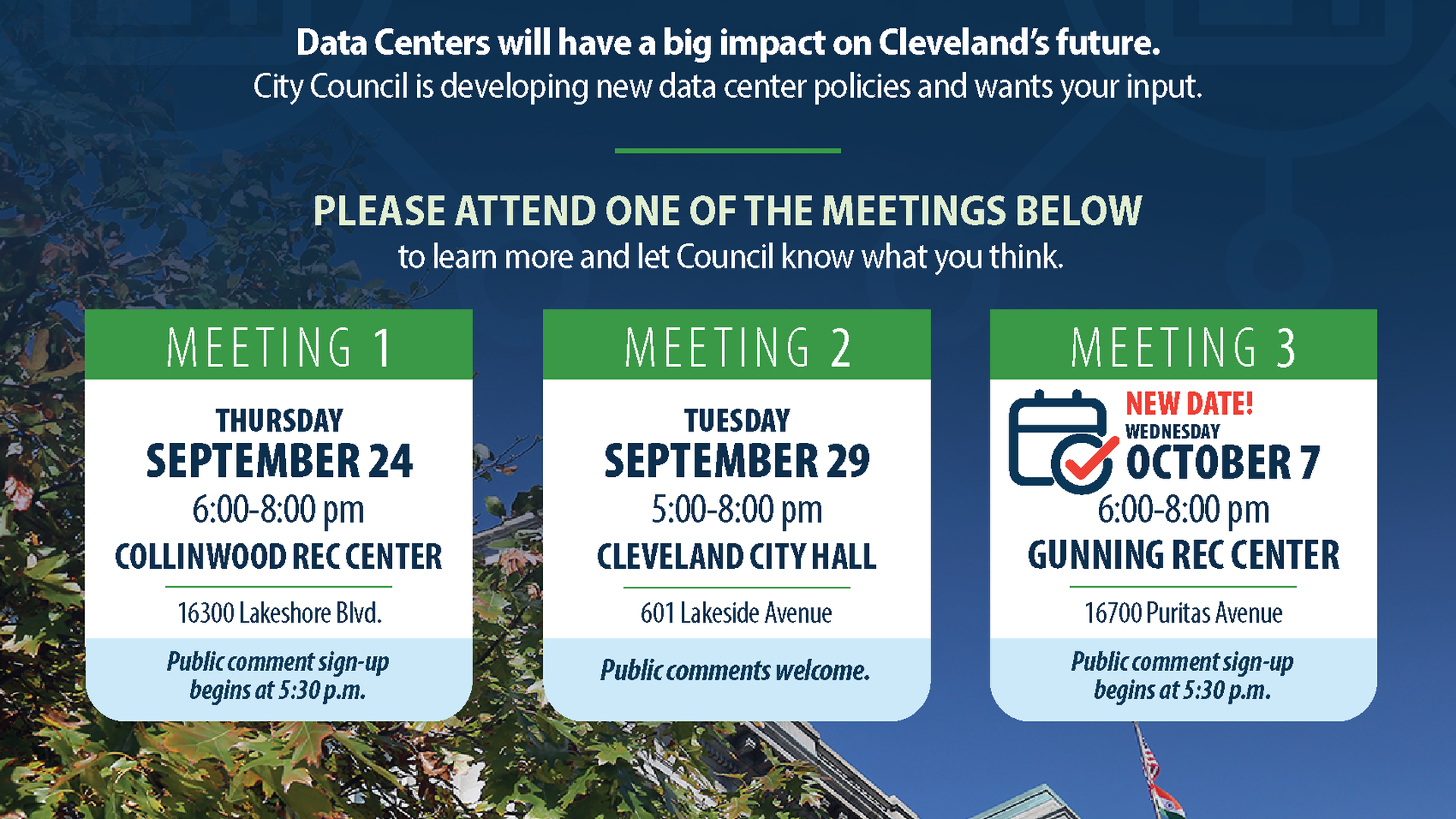
Cleveland is beginning a public process to shape rules for data centers as the city’s temporary construction moratorium approaches its October expiration.
Councilmember Brian Kazy announced three hearings—two at recreation centers and one at City Hall—and the city launched an online survey for residents.
The pause gives officials time to address zoning, utility capacity, water use and whether facilities should be kept away from residential neighborhoods.
Cleveland has smaller data centers but no hyperscale facility; the city denied a permit for what would have been its first, in Slavic Village.
Kazy said opposition often focuses on large facilities serving artificial intelligence or cryptocurrency operations, while also stressing that data centers support routine activities such as card payments and mobile phones.
Key facts:
Brian Kazy announced three public hearings scheduled for September 24, September 29 and October 7.
Cleveland launched an online survey to gather residents’ views on data center policy.
The city’s moratorium pauses new data center construction and ends in October, with a possible extension.
Cleveland denied a permit for what would have been its first hyperscale data center in Slavic Village.
Council is examining zoning, electricity, water capacity and residential-neighborhood siting.
Why it matters: Cleveland is turning a temporary construction pause into a broader policy decision. The hearings and survey give residents a formal role while council considers how much infrastructure large facilities could require and where they could be built.
The moratorium also keeps new projects on hold while the rules are developed.
The key next step is whether council extends the pause beyond October and what regulations emerge for facilities associated with artificial intelligence and other high-demand computing.
House passes data-center ratepayer bill by 417-3 vote
Congress is moving toward a new rule for the power costs of America’s AI buildout. On Sept. 16, the House passed the bipartisan Ratepayer Protection Act 417-3, sending it to a Senate that has not yet acted on the measure.
The bill would establish a federal framework that state utility regulators could adopt for data centers drawing at least 100 megawatts.
Under that framework, large facilities would cover power-generation, transmission and related infrastructure costs rather than shifting them to households and small businesses.
The vote reflects mounting political backlash, but it does not settle the policy fight: environmental groups argue the approach is too weak, while some lawmakers want a broader pause or moratorium on new facilities.
Key facts:
The House passed the Ratepayer Protection Act 417-3 on Sept. 16.
The bill targets AI data centers requiring at least 100 megawatts of demand.
State regulators could adopt standards billing large-load customers for new generation and transmission infrastructure.
The Senate has not acted on the measure or its own data-center bills.
Environmental groups said voluntary state adoption may be insufficient.
Why it matters: The immediate effect is limited: the House bill does not impose a nationwide charge or guarantee state adoption.
If enacted and adopted, it would shift more grid-expansion costs from utility customers to the companies creating new demand, potentially changing project economics and utility negotiations.
Opponents argue its voluntary design could leave residents exposed, while Food & Water Watch said it could speed construction.
Senate action is the next major checkpoint, especially as lawmakers approach the election recess and pressure grows for broader AI and data-center regulation.
Philadelphia protesters demand three-year pause on data center construction
About 100 protesters gathered outside Philadelphia City Hall on September 14, demanding a three-year moratorium on data center construction.
Residents and environmental groups urged Mayor Cherelle Parker and City Council to establish strict rules before approving facilities designed to support artificial intelligence growth.
Philadelphia currently has no local zoning laws or regulations governing data center development.
Pennsylvania Gov. Josh Shapiro signed an executive order last month aimed at mitigating data center impacts, but it stopped short of a moratorium; Council President Kenyatta Johnson has not committed to one, saying members are discussing the city’s approach.
Key facts:
About 100 protesters rallied outside Philadelphia City Hall on September 14, 2026.
The No Data Centers in Philly coalition requested a three-year construction moratorium.
Philadelphia has no local zoning laws or regulations governing data center development.
Council President Kenyatta Johnson has not committed to a moratorium.
Gov. Josh Shapiro signed an executive order aimed at mitigating data center impacts.
Why it matters: The protest turns data center expansion into a local governance and permitting issue, not just an AI infrastructure story.
Without city-specific rules, residents are pressing officials to define protections before development advances, while the state has already chosen a narrower intervention than the coalition wants.
The next consequential step is whether City Council creates a moratorium or establishes a regulatory process.
The dispute also reflects broader concerns over data centers’ pressure on electricity systems and household energy costs, which could shape public resistance to future projects.