YC leads ByteAsk’s $1 million round; OpenAI hires Sam Yam; Ordo joins Fall 2026 batch
Y Combinator’s latest developments span early funding, new accelerator entrants and startups adding finance, engineering and growth infrastructure as they scale. The expansion also highlights pressure points: regulated workflows and enterprise security require tighter controls, while OpenAI’s creator push and Sam Altman’s warning underscore the governance challenges of increasingly autonomous AI.
Thursday, Sep 24, 2026
Tracking: Y Combinator
Geography: San Francisco Bay Area, Mountain View, United States
YC Leads $1 Million Round for AI Coding Startup ByteAsk
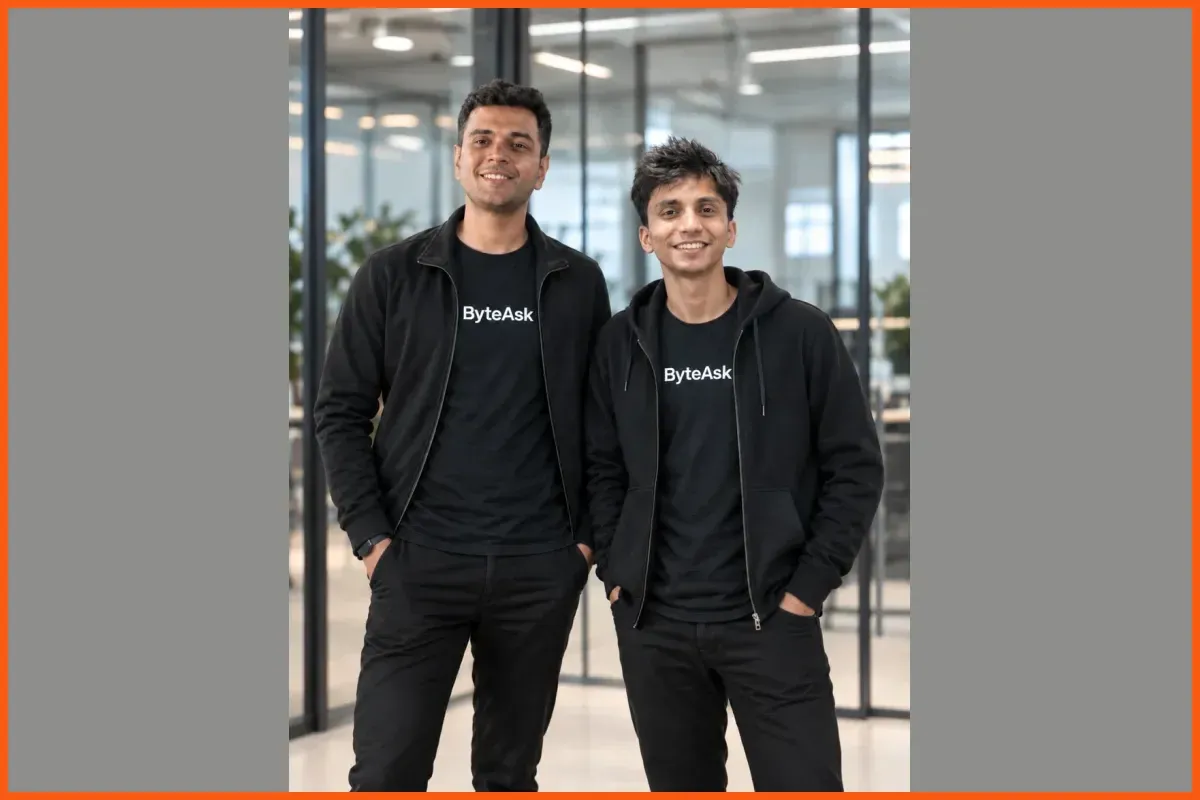
ByteAsk, a San Francisco AI startup founded in June 2026, has raised $1 million in a pre-seed round led by Y Combinator, with Entrepreneur First and angel investors participating.
The company is also in YC’s Fall 2026 batch, where ET Entrepreneur identifies it as one of five India-founded companies and the only “neolab” company.
Founded by IIT Delhi alumni Anirudha Kulkarni and Pratyush Saini, ByteAsk is building coding agents for C and C++ software used in trading, automotive, aerospace, defense, robotics and semiconductors.
It plans to spend the funding on product development, engineers in San Francisco and India, GPU computing, training data, and enterprise security and on-premises infrastructure.
ByteAsk says its internal firmware benchmark resolved 89% of tickets, versus 61% for a frontier model tested without its grounding environment.
Key facts:
ByteAsk raised $1 million in its first disclosed funding round on September 24, 2026.
Y Combinator led the round; Entrepreneur First and angel investors also participated.
The company joined YC’s Fall 2026 batch as one of five India-founded companies.
Its agents target C and C++ codebases in trading, automotive, defense, and other critical industries.
ByteAsk’s internal benchmark showed 89% resolution versus 61% for a frontier model without grounding.
Why it matters: ByteAsk is pursuing a specialized enterprise position in AI coding: improving debugging, performance, memory use and verification in C++ environments where reliability matters more than rapid code generation.
Its planned security, privacy and on-premises features address the deployment constraints of sensitive industries, while YC’s network could support hiring, investor access and customer development.
The next tests are whether the startup can convert its internal benchmark and reported usage growth into enterprise adoption, and whether its planned C++-specific model arrives within six to eight months.
The funding gives ByteAsk capital to build that infrastructure, but its strategy also requires convincing large customers that specialized agents outperform broader coding tools on production systems.
Ordo Labs joins Y Combinator with $500,000 in funding

Stockholm-based Ordo Labs has joined Y Combinator’s Fall 2026 batch, securing the accelerator’s standard $500,000 investment.
Founded by Kristina Hoang, Sebastian Apelgren, and Adam Tovatt, the company is building an AI workspace for regulated science labs, where software must operate within strict compliance rules.
Ordo says it is already running paid pilots with laboratories in Sweden and abroad. Before YC, it raised an undisclosed angel round from Wave Ventures, Johannes Schildt, and Ekaterina Gianelli, after participating in KTH Innovation Launch’s batch 22.
Its admission makes Ordo the third Sweden-based startup to announce joining the Fall 2026 cohort, while other Swedish-founded companies are also represented in the batch.
Key facts:
Ordo Labs joined YC’s Fall 2026 batch, announced September 24, 2026.
$500,000 is the accelerator’s standard first funding for Ordo Labs.
Founders are Kristina Hoang, Sebastian Apelgren, and Adam Tovatt.
Ordo reports paid pilots with laboratories in Sweden and abroad.
Wave Ventures, Johannes Schildt, and Ekaterina Gianelli provided undisclosed prior angel funding.
Why it matters: Ordo enters Y Combinator with early commercial evidence rather than only a product concept: the company reports paid pilots and had already attracted angel backing.
Its focus on regulated science also positions it in a market where adoption depends on combining faster workflows with compliance.
The next test is whether those pilots become repeatable business and whether the $500,000 investment helps Ordo expand beyond its initial laboratory customers.
The company’s progress will also provide an early signal for investor appetite around AI tools serving highly regulated research environments.
OpenAI hires Patreon co-founder to lead creator products

OpenAI has hired Sam Yam, Patreon’s co-founder, to lead its creator products, according to a September 23 report from Mashable. The appointment gives OpenAI’s expanding creator push a named executive leader, with further details expected at DevDay.
The development comes alongside a separate September 24 report on CEO Sam Altman’s warning to the UN Security Council about increasingly capable AI.
Altman said such systems could move faster than institutions, concentrate power in too few hands, or make decisions people no longer understand or control, and called for “extreme care.
” Together, the reports show OpenAI broadening its product ambitions while publicly acknowledging the governance challenges created by more autonomous AI.
Key facts:
OpenAI hired Sam Yam, Patreon’s co-founder, on September 23, 2026.
Yam will lead OpenAI’s creator products, with more details expected at DevDay.
Sam Altman warned the UN Security Council about increasingly capable AI on September 24.
Altman said AI could outpace institutions and concentrate power in too few hands.
Why it matters: Yam’s appointment makes creator products a defined leadership area inside OpenAI and sets DevDay as the next checkpoint for details about the strategy.
That gives startup founders and investors a concrete signal to watch: whether OpenAI’s creator push becomes a broader product or partnership platform. Altman’s warning adds a governance lens to the expansion.
OpenAI is pursuing new applications for increasingly autonomous systems while its CEO argues that institutions may struggle to keep pace, making product direction and oversight increasingly connected.
YC-listed Archer builds AI-driven business banking around programmable payments
Y Combinator describes Archer as an early-stage company building an AI-driven banking platform for businesses, with money movement controlled by natural-language instructions.
Its system connects business events to payroll, vendor payments, incentives, and cash management, using stablecoin rails and non-custodial infrastructure to execute transactions automatically.
Archer is also hiring a full-stack engineer with React, Node.js, TypeScript, and web3 experience, suggesting the product remains under active construction.
Separately, YC alumnus Eduardo Candela is preparing to pitch his new company, Sotant, at an in-person a16z Speedrun event on October 6.
His comparison of YC and Speedrun highlights a tradeoff between YC’s large founder network and Speedrun’s closer partner involvement.
Key facts:
Y Combinator’s September 24 page describes Archer as building AI-driven business banking.
Archer uses natural-language instructions to program payments, incentives, and cash management.
Archer’s infrastructure combines stablecoins, non-custodial systems, and AI agents.
Archer is recruiting a full-stack engineer experienced with React, Node.js, TypeScript, and web3.
Eduardo Candela will pitch Sotant at a16z Speedrun on October 6.
Why it matters: Archer is targeting a costly administrative layer in startup finance: linking payments to measurable business events instead of managing separate spreadsheets, payment processors, and incentive tools.
If its automation works reliably, finance and growth teams could gain faster, more flexible payouts while Archer positions stablecoins as business infrastructure rather than a speculative product.
The hiring profile shows the execution challenge: the company needs financial automation, scalable software, and crypto infrastructure in one product.
Candela’s account adds a separate signal about accelerator strategy: YC offers unusually broad founder access, while a smaller program may provide more hands-on help with sales, branding, and pitching.
Watch whether Archer converts its product vision into customer adoption and whether Sotant’s in-person demo produces investor interest.
YC’s September directory highlights a new wave of AI infrastructure and workflow startups

Y Combinator’s startup directory, dated September 24, 2026, profiles newer companies across infrastructure, collaboration, human resources, and education.
The infrastructure page lists 284 companies, including San Francisco startups from the P2026 and W2026 batches building data, networking, automation, monitoring, and agent infrastructure.
The listings point to a broader push to apply artificial intelligence to operational work.
Hub supplies real-world data to frontier AI and robotics companies; Minicor connects agents to desktop software without APIs; Lantern AI automates hiring workflows; and Bloomy offers an AI-native academic system for K–12 schools.
Risely AI says it reached $8,000 in monthly recurring revenue six weeks after launch, growing 55% week over week. These are separate directory updates, not a single YC cohort or funding announcement.
Key facts:
YC’s infrastructure directory lists 284 companies and includes San Francisco-based P2026 and W2026 startups.
Hub, a P2026 company, provides multimodal data to frontier labs and robotics companies.
Minicor connects AI startups with legacy desktop applications lacking APIs.
Lantern AI automates sourcing, interviews, assessments, candidate communication, and offers.
Bloomy, a San Francisco S2026 startup, markets an AI-native K–12 academic system.
Why it matters: The directory updates show YC-backed founders targeting the infrastructure and administrative bottlenecks that could limit wider AI adoption.
Instead of building only end-user chat products, these startups are working on data supply, legacy software access, agent reliability, hiring, school administration, and university operations.
For investors and prospective founders, the pages offer a snapshot of where early-stage experimentation is concentrating across YC’s network.
They also show the limits of the signal: the entries provide company descriptions, locations, employee counts, and cohort labels, but generally do not establish round sizes, valuations, or investor participation for the newer companies.
YC-Backed Emergent Claims $130 Million Run Rate, Hiring Finance Manager
Emergent.sh, a San Francisco startup backed by Y Combinator and several major investors, is recruiting a finance manager to run operations across its India and US entities.
The September 24 listing describes a first-of-function role covering payments, treasury, billing, compliance, controls and audits, suggesting the company is formalizing financial infrastructure as it expands.
The company says it has crossed $130 million in annualized revenue, reached more than 10 million users in 190-plus countries, and supported 12 million applications.
But the same posting also says Emergent reached $15 million in annual recurring revenue within 90 days and has users in 180-plus countries, leaving its published traction figures internally inconsistent.
The listing names Creaegis, Khosla Ventures, SoftBank, Lightspeed, Together, Y Combinator, Google, Claypond and Sentinel Global as backers.
Key facts:
Emergent’s September 24 listing seeks a finance manager for India and US entities.
The company says it has $130 million in annualized revenue and more than 10 million users.
The posting separately says Emergent reached $15 million ARR within 90 days.
Emergent lists Y Combinator, Lightspeed, SoftBank, Khosla Ventures and others among its backers.
Why it matters: For the YC and seed-investor ecosystem, this is a concrete sign of an alumni company presenting itself as moving beyond product buildout toward financial discipline across jurisdictions.
The role’s remit—cash, collections, foreign exchange, payroll coordination and controls—shows where scaling pressure lands when an AI startup sells globally.
The main diligence issue is measurement, not momentum: two different revenue and geography snapshots appear in the same listing.
Investors, prospective hires and customers should seek reconciled definitions, dates and counting methods for annualized revenue, recurring revenue, users and applications.
YC-backed Pennant opens NYC office and hires across AI and growth
Pennant, a Y Combinator-backed startup, is opening a New York City office and recruiting across commercial and technical roles, according to three job listings published September 23–24.
The company says it is “fresh off the summer batch” and requires in-person work for the roles.
The postings show a startup moving beyond the accelerator’s cohort stage: it is seeking a seasonal Founder Fellow for go-to-market, growth and strategy, another for applied AI, and a full-time founding engineer for data and AI.
Pennant is building software for corporate governance, initially focused on proxy voting and shareholder/company engagement, with a longer-term aim of connecting policies, decisions and outcomes in a “world model.
” The technical role would own a prioritized data pipeline, while the fellows support customer growth and model quality.
Key facts:
Pennant is opening a New York City office and requires in-person work for the advertised roles.
Three Pennant listings appeared on Y Combinator’s site between September 23 and 24, 2026.
Roles span go-to-market, applied AI, and a full-time founding data-and-AI engineering position.
Pennant’s initial product targets proxy voting and shareholder/company engagement.
Technical hires will work on document extraction, data pipelines, evaluations, and production reliability.
Why it matters: The hiring mix suggests Pennant is building customer acquisition and technical reliability at the same time.
Its go-to-market fellow will support market research, messaging, outreach and growth metrics, while technical hires will improve document extraction, evidence tracking and production systems used in governance decisions.
For the Y Combinator ecosystem, this is a concrete post-batch operating milestone: an office opening and several founder-led hires rather than a batch announcement alone.
The listings establish hiring activity, but provide no funding or customer-count milestone, so the next signals to watch are full-time conversions, customer expansion and additional capital announcements.