ASEAN Tests Cooperation as Regional Risks Outrun Its Systems
ASEAN is moving from broad commitments toward practical cooperation on food safety, digital trade, defense dialogue, connectivity and energy, but uneven national capacity remains the main constraint—as the limited response to transboundary haze makes clear. Watch whether closer coordination among Singapore and Thailand, Vietnam’s expanding regional outreach, and ASEAN’s engagement with Myanmar can produce workable mechanisms without deepening divisions over consensus and implementation.
Wednesday, Sep 2, 2026
Tracking: ASEAN regional security · ASEAN member states · ASEAN
Geography: Southeast Asia, Brunei, Cambodia, Indonesia, Laos, Malaysia, Myanmar, the Philippines, Singapore, Thailand, Vietnam
Myanmar’s Min Aung Hlaing Plans Vietnam Visit as ASEAN Outreach Expands
Myanmar’s state media says military-appointed President Min Aung Hlaing will soon visit Vietnam at President To Lam’s invitation, but Hanoi has not confirmed the trip.
He is due to meet Lam, Prime Minister Pham Minh Chinh, National Assembly chief Tran Thanh Man, and economic representatives, with talks focused on bilateral relations and cooperation.
The announcement follows Vietnamese Foreign Minister Le Hoai Trung’s visit to Myanmar last week—the first by Vietnam’s foreign minister since the 2021 coup.
The outreach signals Hanoi joining mainland Southeast Asian neighbors in direct engagement as Myanmar seeks normalized ASEAN ties, even while the bloc excludes it from summits over failure to implement the Five-Point Consensus.
The planned visit comes before November’s ASEAN summit, where divisions between engagement-minded mainland states and maritime members could shape Myanmar’s prospects.
Key facts:
Myanmar state media announced Min Aung Hlaing’s Vietnam visit for the near future.
Vietnam has not publicly confirmed the planned presidential visit.
Le Hoai Trung became Vietnam’s first foreign minister to visit Myanmar since the 2021 coup.
Myanmar has been excluded from ASEAN summits since late 2021.
Laos, Thailand, Cambodia, and Vietnam have invited Min Aung Hlaing.
Why it matters: A Hanoi visit would give Myanmar’s leadership another direct ASEAN channel as it presses for full participation in regional mechanisms.
Vietnam’s foreign minister already discussed trade, investment, and mutual support at international forums, making the planned presidential visit a potential vehicle for practical ties and diplomatic backing.
At the bloc level, however, this is calibrated reengagement, not a settlement of Myanmar’s exclusion.
It underscores the divide before November’s summit: mainland states favor contact, while Singapore, Indonesia, and Malaysia have advocated a stronger response, and ASEAN continues to tie summit access to implementation of the Five-Point Consensus.
Singapore and Thailand Set Joint Agenda for 2027–28 ASEAN Chairmanships
Singaporean Prime Minister Lawrence Wong and Thai Prime Minister Anutin Charnvirakul held the fifth Singapore–Thailand Leaders’ Retreat in Bangkok on 2 September 2026.
Their joint statement advanced a “Forward-Looking Strategic Partnership,” reaffirming defense and economic ties while directing officials to develop cooperation in green and digital economies, artificial intelligence, energy resilience, connectivity, food security and transnational crime.
The larger strategic commitment was ASEAN coordination: Singapore and Thailand will work together during their chairmanships in 2027 and 2028 to advance ASEAN priorities, strengthen integration and deepen cooperation with external partners.
NBT World described four headline pillars—green energy, semiconductor investment, defense technology and regional ASEAN coordination—while the Singapore statement presents a broader cooperation agenda.
The leaders also backed regular high-level exchanges and follow-up through civil-service and economic mechanisms, alongside support for a rules-based international order.
Key facts:
Lawrence Wong and Anutin Charnvirakul held the fifth Leaders’ Retreat in Bangkok on September 2, 2026.
The leaders reaffirmed Singapore–Thailand defense and economic cooperation.
Singapore and Thailand will chair ASEAN in 2027 and 2028, respectively.
Follow-up will use the Civil Service Exchange Programme and STEER ministerial mechanisms.
NBT World identified green energy, semiconductors, defense technology and ASEAN coordination as four pillars.
Why it matters: The agreement creates a coordination channel between two successive ASEAN chairs, potentially improving continuity across the organization’s agenda rather than treating each chairmanship as a separate cycle.
It also links national resilience concerns—including energy, food, digital technology and defense cooperation—to wider regional priorities. The statement sets direction but not detailed projects or timelines.
The next indicator will be whether the CSEP and STEER follow-up meetings produce concrete initiatives, and whether Singapore and Thailand can convert their shared priorities into ASEAN-wide decisions and cooperation with external partners.
Haze Spreads Across Southeast Asia as ASEAN Response Stays Limited
Forest and land fires in Indonesia are sending haze into Malaysia, Singapore and Brunei during an extreme dry season, reviving a regional problem ASEAN has struggled to manage collectively.
Indonesia’s Forestry Ministry recorded more than 202,000 hectares burned from January through July, excluding tens of thousands of hectares affected in August; West, South and Central Kalimantan and Riau were among the hardest-hit areas.
Malaysia reported air-quality readings as high as 158 and sharp weekly increases in respiratory illness, while Singapore’s PSI reached 99 in its central region on Aug. 25.
The 2002 ASEAN Agreement on Transboundary Haze Pollution provides for monitoring, early warnings, information exchange and assistance, but experts quoted by the Jakarta Globe said implementation still depends mainly on national action.
They urged Jakarta to use the ASEAN coordinating centre more fully and convert the agreement into concrete national and local measures.
Key facts:
Indonesia recorded more than 202,000 hectares burned between January and July, excluding August fires.
Haze reached Malaysia, Singapore and Brunei; Malaysia’s API peaked at 158.
Malaysia reported respiratory infections up 124.4% and asthma cases up 259% week-on-week.
Singapore’s PSI reached 99 centrally on August 25, just below unhealthy levels.
ASEAN’s haze agreement entered force in 2003; Indonesia ratified it in 2015.
Why it matters: ASEAN can help states share warnings and resources, but it cannot substitute for domestic enforcement or land-clearing controls.
That leaves Indonesia carrying the main operational burden while neighbors absorb health and air-quality costs; the arrangement also gives Jakarta a diplomatic channel to address complaints before they escalate internationally.
The immediate test is whether Indonesia uses the Jakarta-based coordinating centre for early warnings and regional coordination, and whether members turn the voluntary haze-control fund into practical support.
Longer term, the experts point to national and local rules in Indonesia as the decisive gap between a binding regional framework and results on the ground.
Philippines Presses ASEAN Defense Partners to Preserve Consensus
The Philippines used a virtual ASEAN defense meeting to press member states and outside partners to keep regional security cooperation open, flexible and collective.
The call came during the ASEAN Defense Senior Officials’ Meeting-Plus (ADSOM-Plus), held after the ASEAN Defense Senior Officials’ Meeting. Philippine Defense Undersecretary for Strategic Assessment and Planning Ignacio Madriaga led the session as its chair.
Madriaga urged officials to find common ground despite differences, presenting ASEAN centrality, consensus-building, inclusivity and collective responsibility as the meeting’s guiding principles.
The intervention was a push to preserve a broad, ASEAN-centered process that includes partner countries without abandoning consensus.
The development is therefore a Philippine appeal about the rules of defense diplomacy, rather than a reported deployment or operational measure.
Key facts:
The Philippines urged openness, flexibility and collective responsibility at a virtual ADSOM-Plus meeting.
Undersecretary Ignacio Madriaga chaired the talks after the ASEAN Defense Senior Officials’ Meeting.
Participants included ASEAN defense officials and Plus-country counterparts.
Madriaga emphasized ASEAN centrality, consensus, inclusivity and common ground despite differences.
Why it matters: The intervention gives ASEAN’s consensus model a specific defense-policy emphasis: keep partners engaged while preserving inclusivity and ASEAN centrality.
That approach may help maintain a common forum when members and partners disagree, but it places the burden on consensus-building rather than faster collective action.
The key question is whether this principle-setting produces concrete cooperation in subsequent ADSOM-Plus work.
Cambodia Joins ASEAN’s Renewed Call for a Nuclear-Free World
Cambodia has joined ASEAN in renewing its call for a world free of nuclear weapons, according to a September 2 Cambodianess report.
The statement also urges states that have not ratified the Comprehensive Nuclear-Test-Ban Treaty (CTBT) to demonstrate the political will needed to bring the pact into force.
The move places Phnom Penh behind an ASEAN-wide diplomatic appeal centered on nuclear disarmament and the test-ban treaty, and does not announce a new defense arrangement or enforcement measure.
Its immediate consequence is a clearer public position by Cambodia within the bloc; the next indicator will be whether the appeal is followed by concrete ratifications or other steps toward the treaty’s entry into force.
For regional security, it links ASEAN’s collective voice to a global arms-control instrument.
Key facts:
Cambodianess reported the development on September 2, 2026.
Cambodia joined ASEAN’s renewed call for a world free of nuclear weapons.
The appeal urges non-ratifying states to support the CTBT’s entry into force.
Why it matters: The announcement strengthens ASEAN’s shared diplomatic messaging on nuclear disarmament and gives Cambodia a clearly aligned position within that message.
Its effect is principally political and normative, not a change to military capabilities or regional force deployments. The key downstream question is whether states that have yet to ratify the CTBT respond to ASEAN’s appeal.
Concrete ratifications or treaty-related steps would give the bloc’s renewed language greater practical weight.
ASEAN Tests Regional Food-Safety Response as ADB Targets Digital Trade Gaps
ASEAN’s regional cooperation agenda is producing practical tests, but the two latest initiatives point to an execution problem: agreements and emergency systems only work when national agencies can use them.
In a report published August 27, WHO said all 11 ASEAN members had rehearsed a cross-border food-contamination response in Jakarta on July 7–9.
The exercise tested information-sharing, laboratory and epidemiological systems, product tracing and recalls, risk assessment, and public communication, while evaluators found some countries still developing or finalizing response plans.
On August 28, the Asian Development Bank listed an active $450,000 technical-assistance project to study implementation of regional trade agreements, with emphasis on RCEP and ASEAN’s Digital Economy Framework Agreement.
The project will investigate gaps between regional commitments and domestic policy, and how digital agreements interact.
Together, the developments show ASEAN institutions moving from broad commitments toward operational capacity—while exposing uneven readiness as the main constraint.
Key facts:
ASEAN’s 11 member states joined a Jakarta food-safety simulation, July 7–9, 2026.
The exercise tested tracing, recalls, laboratory systems, risk assessment, and public communications.
Evaluators said some countries are still developing or finalizing national response plans.
ADB lists a $450,000 active project focused on RCEP and ASEAN DEFA implementation.
The project will examine gaps between regional commitments and domestic policy frameworks.
Why it matters: These are separate tracks, not a single ASEAN decision. But they reveal the same regional vulnerability: cross-border rules depend on domestic agencies, data-sharing channels, and enforcement.
The food-safety exercise connected national authorities with ASEAN mechanisms such as ARAC and ARASFF, while ADB’s project targets the legal, administrative, and enforcement gaps that can leave trade commitments underused, especially by small and medium-sized enterprises.
Consumers and firms stand to benefit if the work leads to faster recalls and more usable digital trade rules. The immediate risk is uneven implementation: some states may be ready to coordinate while others are still building basic plans or policy frameworks.
Watch whether ASEAN members repeat simulations, complete response plans, and translate DEFA commitments into national measures; the reports establish these as the next practical tests, not guaranteed outcomes.
Vietnam Pitches ASEAN Connectivity as Energy Risks Grow
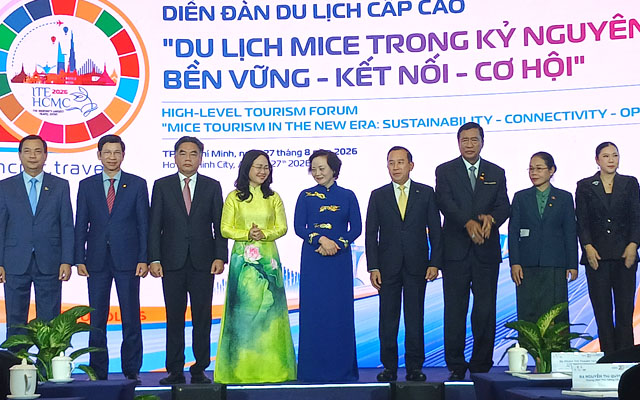
Vietnam used high-level meetings on September 2 to present itself as a connector for ASEAN’s economic and regional resilience agendas.
At ITE HCMC, Deputy Prime Minister Pham Thi Thanh Tra urged Southeast Asian countries to build a shared MICE network—business-events routes combining destinations, air services and joint promotion—while Cambodia endorsed complementary itineraries.
At a Russia-ASEAN dialogue in Vladivostok, Finance Minister Ngo Van Tuan proposed a Far East–Vietnam–ASEAN logistics corridor and cooperation in technology, energy and investment.
The proposals arrive as ASEAN’s energy-security agenda broadens beyond fuel supplies.
Fulcrum’s analysis says rising electricity demand and deeper grid integration could diversify energy sources, but also expose the region to infrastructure, climate, supply-chain and cybersecurity risks.
The Russia-ASEAN action plan for 2026–30 and planned ASEAN Power Grid expansion now face the test of turning connectivity ambitions into funded projects and workable regional governance.
Key facts:
Vietnam urged ASEAN to develop multi-country MICE routes and joint destination promotion.
Cambodia proposed combining conferences in Ho Chi Minh City with incentive travel in Siem Reap.
Russia-ASEAN trade reached approximately US$21 billion in 2025, up nearly 58% over a decade.
Vietnam proposed a Far East–Vietnam–ASEAN logistics corridor linking ports, storage and production networks.
ASEAN’s cross-border electricity capacity stood at 7.7 gigawatts in 2025.
Why it matters: Vietnam is seeking influence by positioning itself as a practical gateway: linking Russian businesses with ASEAN markets, connecting regional tourism products, and supporting logistics, technology and investment flows.
If adopted, these initiatives could benefit businesses across multiple ASEAN countries while strengthening Vietnam’s role in regional economic diplomacy. The energy dimension carries a harder security trade-off.
Cross-border power links can reduce exposure to external oil and gas shocks, but greater interdependence also raises the consequences of grid failures, extreme weather, supply-chain disruption and cyberattacks.
The key test is whether ASEAN converts its plans into infrastructure investment and governance arrangements capable of managing those shared vulnerabilities.